Source : The Straits Times, August 22, 2009
In mid-1990s, many made mistake of thinking prices would keep going up
IN 1995, Mr Zachary Tsai (not his real name) paid nearly $1.3 million for a second house. A general manager with a manufacturing company in his early 40s, he earned a five-figure salary and lived in a semi-detached house he owned in Upper East Coast with his wife and four children.
But pressured by his 'rich and successful' friends, he decided to pool his hard-earned savings of $300,000 with his sister to put down a deposit on a three-storey cluster house in Kew Gate, a 31-unit leasehold development in the Upper East Coast area.
Intending to sell it about 10 years later, and confident of being able to repay the mortgage and make a handsome profit, he took out a 90 per cent bank loan.
Any thought that he would lose his job and house prices would drop like a stone never occurred to him. But the unthinkable became an unpleasant reality.
In 2001, after his employer merged with another company, he lost his job.
He managed to cover monthly payments on the loan with the remnants of his savings, but that did not leave much for his family.
Desperate to make ends meet, he tried to sell the cluster house in which his sister and mother had been living, but for two long years was unable to do it.
Although he managed to secure a new job in 2003, his salary barely covered the monthly payments. Then the Sars crisis hit and property prices plunged further, recalls Mr Tsai, who is now an operational manager in his late 50s. He eventually disposed of the house at a bank foreclosure sale in 2003 for $680,000 - almost half of the original value and $300,000 below valuation. In total, he lost about $700,000 on the house.
The Tsais, who had to sell their semi-detached home to pay off the debt, now own and live in a five-room HDB flat - also in the Upper East Coast area - bought with Mr Tsai's Central Provident Fund savings. 'I've dreamed of owning private property again and going back to a semi-D. But next time I'm not going to think twice - I'm going to think three or four times,' Mr Tsai says.
Home owner M.K. Kung, 42, has also been hit by shrinking values.
She purchased a two-bedder at Yio Chu Kang condo Seasons Park in 1996 with her husband for about $700,000. They are still living there with their child, but she reckons the apartment is now worth only $650,000 or less.
'We have been thinking of upgrading, but it's not easy to sell something when you know you're going to make a loss on it,' says the public accounting executive.
Mr Tsai and Mrs Kung - along with thousands of others - had bought into what PropNex chief executive officer Mohamed Ismail terms 'the myth that prices would only keep going up'.
'Prior to that we had little experience of prices being crushed. Queueing up for two, three days was common, and queue spots were changing hands for $15,000 to $30,000,' he says. Some property analysts draw parallels with the upbeat market we have today, but are keen to point out differences between the last property crash and today's situation.
DTZ's head of South-east Asia research Chua Chor Hoon says: 'The market right now is reminiscent of 1996 in atmosphere with the queues, the packed showrooms and good take-up rates for popular projects.
'But the level of speculation now has not reached the feverish state seen in 1996 and it's still too early to tell whether it will turn out the same way.''
Dr Chua Yang Liang, head of Southeast Asia research at Jones Lang LaSalle, agrees: 'It seems that there is a market euphoria that is quite similar to that in 1996...but the market fundamentals are quite different.'
What may cut the danger of another crash is the fact that properties in many areas are still worth less than at the time of their launch, while others have made only relatively small gains. Prices still have a lot of catching up to do, just to make up for inflation over the years.
Recent transaction data from the Urban Redevelopment Authority website shows that suburban properties launched in 1996 lost more value over the past 13 years than those in prime districts, some of which have actually risen in value.
Prices at Seasons Park, where Mrs Kung lives, have fallen from $610-$670 per sq ft (psf) at launch to around $520 psf now. And Hougang Green units now fetch around $520 psf, down from their average launch price of $560 psf.
At Ardmore Park in Orchard, however, the 2,885 sq ft apartments, launched at an average of $1,850 psf in 1996, have been selling for $1,976-$2,513 psf since August last year.
'The average price of resale leasehold suburban properties in the second quarter of this year was about a quarter below that in the second quarter of 1996; whereas the average price of resale freehold properties in prime districts in the second quarter of this year was about 5 to 10 per cent above that in the second quarter of 1996,' Ms Chua points out.
Ms Tay Huey Ying, director for research and consultancy at Colliers International, explains: 'Prime district prices recovered in the property boom of 2007 but the mass market recovery came later and was short-lived due to the United States sub-prime mortgage crisis.'
Current launches in suburban areas, such as Optima in Tanah Merah and Centro Residences in Ang Mo Kio, have sold for about $810 psf and around $1,170 psf respectively, on average. These are record prices in their districts.
Asked whether such new launches are overvalued, Dr Chua says: 'It's hard to tell now. There are no signs pointing to a major correction...but I don't think the current rate of price increase is sustainable if it is not supported by economic growth.'
Showing posts with label Miscellaneous. Show all posts
Showing posts with label Miscellaneous. Show all posts
Monday, August 24, 2009


Tuesday, August 11, 2009
Kebun Bahru Station? Where's That?
Source : The Straits Times, August 8, 2009
LTA dismisses 'future MRT stations' appearing in condo sales pitches
UOL's ad for an upcoming condo in last week's Sunday Times showed 'planned stations' like Springleaf and Kebun Bahru, even though the LTA has not confirmed any such sites.
 THE proximity of MRT stations to new housing projects has long been a selling point when developments are launched, and it is common to find condominium advertisements displaying 'nearby' train stations.
But a couple of developers have taken the sales pitch one step further: by pinpointing the sites of MRT stations which have not been confirmed.
In UOL Developments' recent advertisement for Meadows@Pierce, a freehold condominium project in Upper Thomson Road expected to be ready around 2012, the developer ran a map showing station sites of the future Thomson Line, which will only be completed in 2018.
These include 'Springleaf', 'Kebun Bahru', 'Venus Drive' and 'Sin Ming' stations.
Another major developer, Far East Organization, showed the location of a 'Marine Parade MRT' station in an online page for its Silversea condo. The east coast development is expected to attain TOP in 2014.
The station is supposedly part of the Eastern Region Line, which will be completed in 2020.
The Land Transport Authority has not confirmed the alignment of the new rail projects, much less the location of stations. An LTA spokesman dismissed the developers' information as 'wild guesses'.
Far East Organization declined to comment; but Ms Claire Cher, spokesman at UOL Group, parent company of UOL Developments, said it got the location and names of the stations from singeo.com - an online map service.
According to the website, the names and locations of the supposed Thomson Line stations were suggestions from users.
Ms Cher nevertheless stood by the advertisement, saying 'we're not misleading, because we put the word 'planned' under each of the station site'.
The Consumers Association of Singapore does not quite agree.
Case executive director Seah Seng Choon said that it fell short of the advertising industry's code of practice, which dictates that all advertisements should be 'legal, decent, honest and truthful'.
'In this case, the sites of the MRT stations as indicated in the advertisement are questionable when the LTA has not confirmed them. As such the advertisement could be misleading.'
Other developers interviewed said it is an occasional practice among some players to include hypothetical sites of new stations in their sales materials - although some frown upon it.
Mr Gerry de Silva, head of group corporate affairs at City Developments, said his company does not resort to this.
Ms Sarah Jane Smith, spokesman for SC Global Developments, said her company has never had to do so because 'all our properties have been very centrally located, so all MRT stations and lines are well established'.
The inclusion of transit stations in property ads is tightly controlled in advanced countries. In Japan for instance, the Real Estate Fair Trade Council says 'future lines or stations are not allowed to be presented in sales collaterals unless the plan is already announced to the public by the transportation company'.
Even so, the line's planned start of operation has to be clearly stated. And the walking distance between MRT station and development has to be made known.
LTA dismisses 'future MRT stations' appearing in condo sales pitches
UOL's ad for an upcoming condo in last week's Sunday Times showed 'planned stations' like Springleaf and Kebun Bahru, even though the LTA has not confirmed any such sites.
 THE proximity of MRT stations to new housing projects has long been a selling point when developments are launched, and it is common to find condominium advertisements displaying 'nearby' train stations.
But a couple of developers have taken the sales pitch one step further: by pinpointing the sites of MRT stations which have not been confirmed.
In UOL Developments' recent advertisement for Meadows@Pierce, a freehold condominium project in Upper Thomson Road expected to be ready around 2012, the developer ran a map showing station sites of the future Thomson Line, which will only be completed in 2018.
These include 'Springleaf', 'Kebun Bahru', 'Venus Drive' and 'Sin Ming' stations.
Another major developer, Far East Organization, showed the location of a 'Marine Parade MRT' station in an online page for its Silversea condo. The east coast development is expected to attain TOP in 2014.
The station is supposedly part of the Eastern Region Line, which will be completed in 2020.
The Land Transport Authority has not confirmed the alignment of the new rail projects, much less the location of stations. An LTA spokesman dismissed the developers' information as 'wild guesses'.
Far East Organization declined to comment; but Ms Claire Cher, spokesman at UOL Group, parent company of UOL Developments, said it got the location and names of the stations from singeo.com - an online map service.
According to the website, the names and locations of the supposed Thomson Line stations were suggestions from users.
Ms Cher nevertheless stood by the advertisement, saying 'we're not misleading, because we put the word 'planned' under each of the station site'.
The Consumers Association of Singapore does not quite agree.
Case executive director Seah Seng Choon said that it fell short of the advertising industry's code of practice, which dictates that all advertisements should be 'legal, decent, honest and truthful'.
'In this case, the sites of the MRT stations as indicated in the advertisement are questionable when the LTA has not confirmed them. As such the advertisement could be misleading.'
Other developers interviewed said it is an occasional practice among some players to include hypothetical sites of new stations in their sales materials - although some frown upon it.
Mr Gerry de Silva, head of group corporate affairs at City Developments, said his company does not resort to this.
Ms Sarah Jane Smith, spokesman for SC Global Developments, said her company has never had to do so because 'all our properties have been very centrally located, so all MRT stations and lines are well established'.
The inclusion of transit stations in property ads is tightly controlled in advanced countries. In Japan for instance, the Real Estate Fair Trade Council says 'future lines or stations are not allowed to be presented in sales collaterals unless the plan is already announced to the public by the transportation company'.
Even so, the line's planned start of operation has to be clearly stated. And the walking distance between MRT station and development has to be made known.
Thursday, August 6, 2009
Don't Write Off Old Bungalows
Source : The Business Times, August 06 2009
You can always ask an architect to see how rooms and spaces can be transformed with simple changes.
WHEN one buys a landed property, it is more than likely that it will come with a house attached.
Quite often, however, new owners will demolish the existing house and build a new one from scratch, adding to the money invested in the property. And at an average of $500 psf for construction cost, this can add up to quite a hefty sum. So it may pay to consider the potential of the existing old bungalow instead.
 Anyone with a good eye for architecture should be able to see how rooms and spaces can be transformed with simple changes. But for those without, the best person to ask is an architect.
Transforming old buildings is something architect Mink Tan has had experience with, having won the URA Heritage Award for the Waterboat House on Fullerton Road in 2004.
By reconfiguring the spaces and adding some new ones, he converted the formerly dark and airless Waterboat House into a light and airy lifestyle F&B destination.
Similarly, when Mr Tan was shown around a 14 year old colonial style bungalow that a client was interested in, he could see that it was a building that had potential.
The large house has a built-up area of about 7,500 sq ft house and sits on nearly 16,000 sq ft of prime land. But with a house of this size and design, the rooms tend to be dark.
To address this, Mr Tan simply replaced many of the windows with French windows which are just glass-panel doors that can be opened to let more light in.
'The spaces also didn't feel right,' says Mr Tan. So he created an 'enfilade effect' by opening up the rooms and establishing view corridors that did not exist before.
By simply knocking down some of the bedroom walls to give access to existing ledges, the architect also converted 'dead space' into balconies. Even the roof of the car porch was converted into a terrace simply by introducing new doors.
In other areas of the house, like the kitchen, all it took was some space-planning to turn what was previously a small kitchen into a bigger, wet and dry kitchen.
Not all houses will be as easy to transform, especially if the house happens to be gazetted for conservation, as many of Singapore's grandest bungalows are.
Old bungalows that have been gazetted for conservation can be transformed and remodelled but strict guidelines set by the Urban Redevelopment Authority (URA) must be adhered to.
Many of the conserved bungalows are within the Good Class Bungalow Areas of Chatsworth Park, Holland Park/Ridout Road and Nassim Road/Whitehouse Park and Mountbatten Road.
Bungalows usually consist of the main building and an outhouse for the kitchen, toilets and servants' quarters. For conserved bungalows, only the main house needs to be retained. The outhouse can be demolished to make way for new extensions to the main house.
New extensions may be permitted for additional floor area but this will be subject to Development Control guidelines, the allowable building height of the area, and the requirements of relevant technical departments.
The potential of some of these conservation bungalows also lies in the land on which it is built. Often, the land area can be large enough to be subdivided into smaller plots.
According to the conservation guidelines, in the Good Class Bungalow Areas, a concession to facilitate the subdivision of land allows for one sub-standard plot size of not less than 1,000 sq m to be considered provided the total land area together with the conservation bungalow plot is not less than 2,800 sq m.
Perhaps the most challenging aspect of owning a conservation bungalow is restoring it.
Architect Chan Soo Khian of SCDA Architects has restored several conservation homes and he advises that potential conservation home owners should be happy with the overall spatial quality of the building before buying it because quite often, the buildings are too old to undergo extensive construction work. 'Quite a few of the colonial bungalows have load bearing brick walls on footings that have constrains from guidelines and a structural point of view,' he explains.
The guidelines on conservation are extensive. Apart from restoring design features in the facade, it could also include having to restore original windows, doors, balustrades and even roof tiles.
Even the existing structural system has to be retained and restored.
However, as Mr Chan points out, many are prepared to pay a premium for these old bungalows. 'The clients that buy the conservation properties do so because they love aspects of the heritage properties such as the mature landscape that usually surround the properties,' he adds.
Indeed, such bungalows fall into a niche market that is popular with discerning home buyers. It is a niche that some developers have begun to take notice of.
Boutique developer Satinder Garcha's company Elevation focuses on unique properties in very prime locations. One such property it has recently restored is at Swettenham Road.
The old bungalow was designed by Frank Brewer and built in Late Arts and Crafts style during the colonial era. Frank Brewer incidentally also built the late president Ong Teng Cheong's house in Dalvey Estate.
Mr Garcha added that these old bungalows do certainly have investment potential, more so than regular Good Class Bungalows, 'because of the rarity value and the desirability of these bungalows, especially by foreigners and now increasingly Singaporeans'.
He added that the most coveted are those which are conserved with historic value but restored and modernised with modern conveniences - offering the best of old and new.
You can always ask an architect to see how rooms and spaces can be transformed with simple changes.
WHEN one buys a landed property, it is more than likely that it will come with a house attached.
Quite often, however, new owners will demolish the existing house and build a new one from scratch, adding to the money invested in the property. And at an average of $500 psf for construction cost, this can add up to quite a hefty sum. So it may pay to consider the potential of the existing old bungalow instead.
 Anyone with a good eye for architecture should be able to see how rooms and spaces can be transformed with simple changes. But for those without, the best person to ask is an architect.
Transforming old buildings is something architect Mink Tan has had experience with, having won the URA Heritage Award for the Waterboat House on Fullerton Road in 2004.
By reconfiguring the spaces and adding some new ones, he converted the formerly dark and airless Waterboat House into a light and airy lifestyle F&B destination.
Similarly, when Mr Tan was shown around a 14 year old colonial style bungalow that a client was interested in, he could see that it was a building that had potential.
The large house has a built-up area of about 7,500 sq ft house and sits on nearly 16,000 sq ft of prime land. But with a house of this size and design, the rooms tend to be dark.
To address this, Mr Tan simply replaced many of the windows with French windows which are just glass-panel doors that can be opened to let more light in.
'The spaces also didn't feel right,' says Mr Tan. So he created an 'enfilade effect' by opening up the rooms and establishing view corridors that did not exist before.
By simply knocking down some of the bedroom walls to give access to existing ledges, the architect also converted 'dead space' into balconies. Even the roof of the car porch was converted into a terrace simply by introducing new doors.
In other areas of the house, like the kitchen, all it took was some space-planning to turn what was previously a small kitchen into a bigger, wet and dry kitchen.
Not all houses will be as easy to transform, especially if the house happens to be gazetted for conservation, as many of Singapore's grandest bungalows are.
Old bungalows that have been gazetted for conservation can be transformed and remodelled but strict guidelines set by the Urban Redevelopment Authority (URA) must be adhered to.
Many of the conserved bungalows are within the Good Class Bungalow Areas of Chatsworth Park, Holland Park/Ridout Road and Nassim Road/Whitehouse Park and Mountbatten Road.
Bungalows usually consist of the main building and an outhouse for the kitchen, toilets and servants' quarters. For conserved bungalows, only the main house needs to be retained. The outhouse can be demolished to make way for new extensions to the main house.
New extensions may be permitted for additional floor area but this will be subject to Development Control guidelines, the allowable building height of the area, and the requirements of relevant technical departments.
The potential of some of these conservation bungalows also lies in the land on which it is built. Often, the land area can be large enough to be subdivided into smaller plots.
According to the conservation guidelines, in the Good Class Bungalow Areas, a concession to facilitate the subdivision of land allows for one sub-standard plot size of not less than 1,000 sq m to be considered provided the total land area together with the conservation bungalow plot is not less than 2,800 sq m.
Perhaps the most challenging aspect of owning a conservation bungalow is restoring it.
Architect Chan Soo Khian of SCDA Architects has restored several conservation homes and he advises that potential conservation home owners should be happy with the overall spatial quality of the building before buying it because quite often, the buildings are too old to undergo extensive construction work. 'Quite a few of the colonial bungalows have load bearing brick walls on footings that have constrains from guidelines and a structural point of view,' he explains.
The guidelines on conservation are extensive. Apart from restoring design features in the facade, it could also include having to restore original windows, doors, balustrades and even roof tiles.
Even the existing structural system has to be retained and restored.
However, as Mr Chan points out, many are prepared to pay a premium for these old bungalows. 'The clients that buy the conservation properties do so because they love aspects of the heritage properties such as the mature landscape that usually surround the properties,' he adds.
Indeed, such bungalows fall into a niche market that is popular with discerning home buyers. It is a niche that some developers have begun to take notice of.
Boutique developer Satinder Garcha's company Elevation focuses on unique properties in very prime locations. One such property it has recently restored is at Swettenham Road.
The old bungalow was designed by Frank Brewer and built in Late Arts and Crafts style during the colonial era. Frank Brewer incidentally also built the late president Ong Teng Cheong's house in Dalvey Estate.
Mr Garcha added that these old bungalows do certainly have investment potential, more so than regular Good Class Bungalows, 'because of the rarity value and the desirability of these bungalows, especially by foreigners and now increasingly Singaporeans'.
He added that the most coveted are those which are conserved with historic value but restored and modernised with modern conveniences - offering the best of old and new.
Friday, July 24, 2009
Finding That Jewel Of A House
Source : The Business Times, July 23, 2009
LANDED HOMES
While most bungalow plots are in the central and eastern districts, they can be found anywhere in Singapore
IT'S not called house hunting for nothing. But if you find a gem of a home, the effort will be very much worthwhile.
Some of the more rewarding finds are big bungalow plots in areas outside central Singapore which, for one reason or another, have so far escaped redevelopment.
 By definition, a bungalow here has to be on a site no smaller than 400 square metres and no less than 10m wide. This may be small compared with a Good Class Bungalow (GCB) - 1,400 sq m minimum - but it's twice as big as a semi-detached plot and five times as big as an intermediate terrace (Type II) plot.
Most people associate bungalow plots with the few GCB areas in prime central districts. But at the turn of the 20th century, many of Singapore's wealthy businessmen chose to build homes on the seafront - and it's here that many of these bungalow plots still exist.
One such area is the East Coast. Propnex CEO Mohamed Ismail says Mountbatten and Siglap are good hunting grounds, where such plots may start around $700 per sq ft. 'They make good investments because of the limited supply,' he adds.
A large bungalow site in Mountbatten that was sold in recent years was Chan's Ville, which belonged to the late Chan Ah Kow, patriarch of one of Singapore's leading sports families.
The 55,000 sq ft site was acquired by SC Global for about $11 million in 2004, which worked out to be just $200 psf. In 2005, it was reported that the developer would add four bungalows to the site and sell them for about $5 million each.
About the time Chan's Ville was sold, another bungalow in Mountbatten was sold for $11.8 million or $305 psf for the 38,662 sq ft site. And this site was redeveloped too.
Indeed, with many waking up to the opportunity for redevelopment, the number of large sites on the East Coast has been dwindling.
Still, there are other areas to hunt in, and Mr Ismail suggests Upper Thomson and Braddell Road.
Donald Han, managing director of Cushman & Wakefield, reckons there are about 20,000 detached houses in Singapore, not counting GCBs. Many are in District 15, but other areas include Sunset Way, Jalan Binchang, Westlake estate, Eng Neo Avenue, Faber Park and Serangoon Gardens.
But as Mr Han points out: 'There is hardly enough supply to cater to demand.'
This demand comes from the desire of many Singaporeans to own a landed home.
As an investment, however, landed properties generally give a lower yield of 2 per cent per annum, compared with 3 per cent or more for condominiums, as bungalows are not as easily leased. 'But landed properties tend to be closer to the hearts of owner occupiers and investors alike,' Mr Han says.
William Wong, managing director of RealStar Premier Property Consultant, believes that while most bungalow plots are in the central and eastern districts, 'there are quite a number of them and they can be found anywhere in Singapore'.
Occasionally, bungalow plots in unusual locations are offered by the government.
In 2007, the Urban Redevelopment Authority (URA) auctioned a 4,477 sq ft bungalow plot in Sembawang. After closely fought bidding, the plot sold for $940,000 or $209 psf.
Of course, Sembawang may not be quite the same as Queen Astrid Park - but not many will want to pay between $700 and $1,000 psf for a bungalow plot in a prime district.
What is important to note is that landed housing areas are strictly protected by urban design guidelines. For instance, if you do buy a GCB, you can be sure a condominium is not going to be built on the plot next to yours.
The same cannot be said about plots outside landed housing areas. Indeed, if you happen to come across a detached house sandwiched between condominiums, chances are the area has been gazetted for high-density living.
So before buying landed property - especially if it is outside a safeguarded landed housing area - make sure you check the zoning. This will reveal what can be built. For instance, Mr Wong says mixed zoning means that either terraced, semi-detached or bungalows can be built.
Another important consideration is height restrictions in particular areas. This can significantly alter the redevelopment potential of a site, especially if you intend to build a three-storey house when only two storeys are allowed.
In some instances, landed properties may be in areas that have been rezoned with higher plot ratios. A plot ratio of 1.4 is enough to see neighbourhoods of landed homes slowly redeveloped into apartment buildings. This means that even if most of the properties on the street are landed homes, any of them can be redeveloped as a high rise if the plot is big enough. Of course, for some this represents a windfall.
Steven Ming, Savills director for prestige homes, says the GCB market is extremely active. 'And we can similarly expect demand for detached houses, even those outside GCB areas, to remain strong as well,' he says. 'Recent strong sales have been fuelled by vast liquidity, availability of cheap finance and a general belief that the worst of the global crisis is over and that the panic-selling phase has passed.'
Mr Ming believes that if current buying momentum continues, detached house prices can be expected to appreciate 10-15 per cent during the rest of the year.
LANDED HOMES
While most bungalow plots are in the central and eastern districts, they can be found anywhere in Singapore
IT'S not called house hunting for nothing. But if you find a gem of a home, the effort will be very much worthwhile.
Some of the more rewarding finds are big bungalow plots in areas outside central Singapore which, for one reason or another, have so far escaped redevelopment.
 By definition, a bungalow here has to be on a site no smaller than 400 square metres and no less than 10m wide. This may be small compared with a Good Class Bungalow (GCB) - 1,400 sq m minimum - but it's twice as big as a semi-detached plot and five times as big as an intermediate terrace (Type II) plot.
Most people associate bungalow plots with the few GCB areas in prime central districts. But at the turn of the 20th century, many of Singapore's wealthy businessmen chose to build homes on the seafront - and it's here that many of these bungalow plots still exist.
One such area is the East Coast. Propnex CEO Mohamed Ismail says Mountbatten and Siglap are good hunting grounds, where such plots may start around $700 per sq ft. 'They make good investments because of the limited supply,' he adds.
A large bungalow site in Mountbatten that was sold in recent years was Chan's Ville, which belonged to the late Chan Ah Kow, patriarch of one of Singapore's leading sports families.
The 55,000 sq ft site was acquired by SC Global for about $11 million in 2004, which worked out to be just $200 psf. In 2005, it was reported that the developer would add four bungalows to the site and sell them for about $5 million each.
About the time Chan's Ville was sold, another bungalow in Mountbatten was sold for $11.8 million or $305 psf for the 38,662 sq ft site. And this site was redeveloped too.
Indeed, with many waking up to the opportunity for redevelopment, the number of large sites on the East Coast has been dwindling.
Still, there are other areas to hunt in, and Mr Ismail suggests Upper Thomson and Braddell Road.
Donald Han, managing director of Cushman & Wakefield, reckons there are about 20,000 detached houses in Singapore, not counting GCBs. Many are in District 15, but other areas include Sunset Way, Jalan Binchang, Westlake estate, Eng Neo Avenue, Faber Park and Serangoon Gardens.
But as Mr Han points out: 'There is hardly enough supply to cater to demand.'
This demand comes from the desire of many Singaporeans to own a landed home.
As an investment, however, landed properties generally give a lower yield of 2 per cent per annum, compared with 3 per cent or more for condominiums, as bungalows are not as easily leased. 'But landed properties tend to be closer to the hearts of owner occupiers and investors alike,' Mr Han says.
William Wong, managing director of RealStar Premier Property Consultant, believes that while most bungalow plots are in the central and eastern districts, 'there are quite a number of them and they can be found anywhere in Singapore'.
Occasionally, bungalow plots in unusual locations are offered by the government.
In 2007, the Urban Redevelopment Authority (URA) auctioned a 4,477 sq ft bungalow plot in Sembawang. After closely fought bidding, the plot sold for $940,000 or $209 psf.
Of course, Sembawang may not be quite the same as Queen Astrid Park - but not many will want to pay between $700 and $1,000 psf for a bungalow plot in a prime district.
What is important to note is that landed housing areas are strictly protected by urban design guidelines. For instance, if you do buy a GCB, you can be sure a condominium is not going to be built on the plot next to yours.
The same cannot be said about plots outside landed housing areas. Indeed, if you happen to come across a detached house sandwiched between condominiums, chances are the area has been gazetted for high-density living.
So before buying landed property - especially if it is outside a safeguarded landed housing area - make sure you check the zoning. This will reveal what can be built. For instance, Mr Wong says mixed zoning means that either terraced, semi-detached or bungalows can be built.
Another important consideration is height restrictions in particular areas. This can significantly alter the redevelopment potential of a site, especially if you intend to build a three-storey house when only two storeys are allowed.
In some instances, landed properties may be in areas that have been rezoned with higher plot ratios. A plot ratio of 1.4 is enough to see neighbourhoods of landed homes slowly redeveloped into apartment buildings. This means that even if most of the properties on the street are landed homes, any of them can be redeveloped as a high rise if the plot is big enough. Of course, for some this represents a windfall.
Steven Ming, Savills director for prestige homes, says the GCB market is extremely active. 'And we can similarly expect demand for detached houses, even those outside GCB areas, to remain strong as well,' he says. 'Recent strong sales have been fuelled by vast liquidity, availability of cheap finance and a general belief that the worst of the global crisis is over and that the panic-selling phase has passed.'
Mr Ming believes that if current buying momentum continues, detached house prices can be expected to appreciate 10-15 per cent during the rest of the year.
Thursday, July 9, 2009
Conversion Bid Lost
Source : The Straits Times, July 8, 2009
House attached to it does not sit on a plot big enough for a bungalow
A DECISION in a legal case has just re-affirmed a key principle of property development - a semi-detached house can be converted to a bungalow only if the neighbouring house is also on a plot large enough for a bungalow.
 The 2002 circular stated that 'a semi-detached house can break away if the adjoining semi-detached house is also capable of redeveloping into a standard detached house under prevailing guidelines'. -- ST PHOTO: AZIZ HUSSIN
The case centred on co-owners who wanted planning permission to convert their semi-detached house in the Upper Thomson area into a bungalow.
Madam Borissik Svetlana and her husband Low Eng Pah applied for permission in 2007 - after buying the house - to erect a two-storey bungalow with a basement, an attic and a swimming pool.
Their application was rejected by the Urban Redevelopment Authority (URA) but the couple went to the High Court to get the order overturned.

The High Court said the applicant cannot assume that the URA will allow the couple's house to be redeveloped into a bungalow and then claim they have suffered hardship when their own assumption turned out to be wrong.
The court dismissed their appeal last week and referred to a 2002 URA order that imposed restrictions on the redevelopment of semi-detached houses.
It was concerned that redeveloping some semi-detached houses into bungalows could leave the adjacent semi-detached house with a lop-sided appearance if the land it is on is too small to accommodate a bungalow.
The 2002 circular stated that 'a semi-detached house can break away if the adjoining semi-detached house is also capable of redeveloping into a standard detached house under prevailing guidelines'.
This means that the adjoining semi-detached houses must each stand on at least 400 sq m of land - the minimum plot size for a detached house. The plots must also have a width of 10m.
The couple's semi-detached house at 2 Jalan Chengam sits on 419 sq m of land but the house to which it is attached, 1A, has a plot of only 244.5 sq m.
If their redevelopment plan had been approved, the remaining semi-detached house would become the type of lop-sided home the 2002 circular was drafted to prevent, the High Court said.
Read the full story in Wednesday's edition of The Straits Times.
House attached to it does not sit on a plot big enough for a bungalow
A DECISION in a legal case has just re-affirmed a key principle of property development - a semi-detached house can be converted to a bungalow only if the neighbouring house is also on a plot large enough for a bungalow.
 The 2002 circular stated that 'a semi-detached house can break away if the adjoining semi-detached house is also capable of redeveloping into a standard detached house under prevailing guidelines'. -- ST PHOTO: AZIZ HUSSIN
The case centred on co-owners who wanted planning permission to convert their semi-detached house in the Upper Thomson area into a bungalow.
Madam Borissik Svetlana and her husband Low Eng Pah applied for permission in 2007 - after buying the house - to erect a two-storey bungalow with a basement, an attic and a swimming pool.
Their application was rejected by the Urban Redevelopment Authority (URA) but the couple went to the High Court to get the order overturned.

The High Court said the applicant cannot assume that the URA will allow the couple's house to be redeveloped into a bungalow and then claim they have suffered hardship when their own assumption turned out to be wrong.
The court dismissed their appeal last week and referred to a 2002 URA order that imposed restrictions on the redevelopment of semi-detached houses.
It was concerned that redeveloping some semi-detached houses into bungalows could leave the adjacent semi-detached house with a lop-sided appearance if the land it is on is too small to accommodate a bungalow.
The 2002 circular stated that 'a semi-detached house can break away if the adjoining semi-detached house is also capable of redeveloping into a standard detached house under prevailing guidelines'.
This means that the adjoining semi-detached houses must each stand on at least 400 sq m of land - the minimum plot size for a detached house. The plots must also have a width of 10m.
The couple's semi-detached house at 2 Jalan Chengam sits on 419 sq m of land but the house to which it is attached, 1A, has a plot of only 244.5 sq m.
If their redevelopment plan had been approved, the remaining semi-detached house would become the type of lop-sided home the 2002 circular was drafted to prevent, the High Court said.
Read the full story in Wednesday's edition of The Straits Times.
Tuesday, July 7, 2009
Geylang Market Opens Next Week
Source : The Straits Times, July 7, 2009
THE NEW and upgraded Geylang Serai market will resume business on July 13.
This follows a facelift headed by the National Environment Agency's (NEA) Hawker Centres Upgrading Programme which took 40 months and costs $18.2 million.
 The upgraded Geylang Serai Market will repon on 13 July 2009 after a 40-month makeover. -- ST PHOTO: NG SOR LUAN
The new market is designed to be iconic and simulates the 'rustic quality' of the old kampong houses, said NEA in a statement on Tuesday.
Some of its features include an entrance lobby with an integrated drop-off porch, similar to that of a Malay verandah. Decorative elements such as louvers and timber panels synonymous with features of Malay architecture were integrated in its designs.
Located along Changi Road, the two-storey structure consists of 162 market produce stalls and 34 lock-up stalls on the first storey, and 63 cooked food stalls and 106 lock-up stalls on the second level.
The upgrading also resulted in a more spacious layout, enhanced ventilation and improved fire safety features. For example, all cooked food stalls have been fitted with a new mechanical exhaust system to improve the ventilation of the centre.
The total seating capacity has also been increased by more than 100 per cent to cater to more crowds.
NEA said the new market provides a 'more pleasant and refreshing environment blended with the rustic Malay charms' for marketing and dining needs.
Stallholders are expected to resume business at the hawker centre from July 13 July.
NEA currently manages 109 hawker centres. To date, 74 hawker centres have been upgraded under the upgrading programme.
Some hawker centres that are currently undergoing upgrading include Tekka Centre, Blk 628 Ang Mo Kio Ave 4 and Blk 270 Queen Street.
THE NEW and upgraded Geylang Serai market will resume business on July 13.
This follows a facelift headed by the National Environment Agency's (NEA) Hawker Centres Upgrading Programme which took 40 months and costs $18.2 million.
 The upgraded Geylang Serai Market will repon on 13 July 2009 after a 40-month makeover. -- ST PHOTO: NG SOR LUAN
The new market is designed to be iconic and simulates the 'rustic quality' of the old kampong houses, said NEA in a statement on Tuesday.
Some of its features include an entrance lobby with an integrated drop-off porch, similar to that of a Malay verandah. Decorative elements such as louvers and timber panels synonymous with features of Malay architecture were integrated in its designs.
Located along Changi Road, the two-storey structure consists of 162 market produce stalls and 34 lock-up stalls on the first storey, and 63 cooked food stalls and 106 lock-up stalls on the second level.
The upgrading also resulted in a more spacious layout, enhanced ventilation and improved fire safety features. For example, all cooked food stalls have been fitted with a new mechanical exhaust system to improve the ventilation of the centre.
The total seating capacity has also been increased by more than 100 per cent to cater to more crowds.
NEA said the new market provides a 'more pleasant and refreshing environment blended with the rustic Malay charms' for marketing and dining needs.
Stallholders are expected to resume business at the hawker centre from July 13 July.
NEA currently manages 109 hawker centres. To date, 74 hawker centres have been upgraded under the upgrading programme.
Some hawker centres that are currently undergoing upgrading include Tekka Centre, Blk 628 Ang Mo Kio Ave 4 and Blk 270 Queen Street.
Upgraded Geylang Serai Market To Progressively Reopen From 13 July
Source : Channel NewsAsia, 07 July 2009
The newly upgraded Geylang Serai Market will progressively resume business from 13 July after a 40-month closure.
 This follows a S$18.2m revamp under the National Environment Agency's Hawker Centres Upgrading Programme.
Built on a larger site along Changi Road, the upgraded two-storey Geylang Serai Market is designed to reflect the area's ethnic and cultural heritage.
The building itself bears intricate Malay motifs and design elements, such as sloping roofs, louvres and timber panels, as found in traditional "kampong" houses.
Seating capacity has been doubled and the centre comes with enhanced ventilation and improved fire safety features.
There will be 162 market produce stalls, 63 cooked food stalls and 140 lockable stalls in the centre.
NEA currently manages 109 hawker centres and 74 of these have been upgraded under the Hawker Centres Upgrading Programme. - CNA/ir
The newly upgraded Geylang Serai Market will progressively resume business from 13 July after a 40-month closure.
 This follows a S$18.2m revamp under the National Environment Agency's Hawker Centres Upgrading Programme.
 Built on a larger site along Changi Road, the upgraded two-storey Geylang Serai Market is designed to reflect the area's ethnic and cultural heritage.
The building itself bears intricate Malay motifs and design elements, such as sloping roofs, louvres and timber panels, as found in traditional "kampong" houses.
Seating capacity has been doubled and the centre comes with enhanced ventilation and improved fire safety features.
There will be 162 market produce stalls, 63 cooked food stalls and 140 lockable stalls in the centre.
NEA currently manages 109 hawker centres and 74 of these have been upgraded under the Hawker Centres Upgrading Programme. - CNA/ir
Thursday, July 2, 2009
40 Tenants May Stay On At The Grangeford Under New Leases
Source : Channel NewsAsia, 30 June 2009
After a near month-long tussle, some tenants at The Grangeford may stay on at the condominium after all.
About 40 of them have expressed interest to do so under the leasing agent, Savills, although the actual number could be higher as some enter into joint-leases with others to rent whole apartment units.
 Grangeford condominium
Residents had been given till 5pm on June 30 to vacate the premises after the previous landlord, Ideal Accommodation, got into trouble with the authorities for converting 140 apartments into 600 rooms.
The leasing agent, Savills, is still tallying the total number of tenants who have moved out.
The condominium owner, Cove Developments, said a few tenants have requested for an extension to move due to various reasons such as travelling, and it is considering these on a case-by-case basis.
Authorities were roped in to ensure those leaving did not take more than they came with.
Tenants told Channel NewsAsia they were warned by management that a police report would be made if they took furniture that the apartments had come furnished with.
Out of those who moved, some were unhappy with terms offered by the new leasing agent, which requires them to rent an entire apartment instead of individual rooms.
40 units have been offered at rates ranging from S$2,600 to S$3,500 per month, with a minimum lease period of six months.
Others just had enough of the hassle. Rizky Priandika, an Indonesian student, said: "There are already many problems here so we need to move out already."
Kentaro Fujiyama, an expat working in Singapore for the first time, said: "I cannot live under the contract with them. I haven't got my deposit back and the previous landlord didn't even say sorry."
Another Indonesian student, George Mason, said: "I'm really pissed off now. I've just started staying here for one month and the contract said one year for me."
Cove Developments said the tenancy agreements between Ideal Accommodation and its tenants are a private matter.
At least 10 tenants told Channel NewsAsia they plan to file complaints with the Small Claims Tribunal for deposits ranging from S$1,200 to S$1,800 paid to the previous landlord. Ideal Accommodation could not be reached for comment.
Cove Developments has declined Channel NewsAsia's request to film the interior of the condominium and the tearing down of the illegal partitions. It said that with more people expected to move out on Tuesday, it might be unsafe for the media to be around.
But it added that it is on track to completing the refurbishment of all the apartments by the July 27 deadline. - CNA/vm
After a near month-long tussle, some tenants at The Grangeford may stay on at the condominium after all.
About 40 of them have expressed interest to do so under the leasing agent, Savills, although the actual number could be higher as some enter into joint-leases with others to rent whole apartment units.
 Grangeford condominium
Residents had been given till 5pm on June 30 to vacate the premises after the previous landlord, Ideal Accommodation, got into trouble with the authorities for converting 140 apartments into 600 rooms.
The leasing agent, Savills, is still tallying the total number of tenants who have moved out.
The condominium owner, Cove Developments, said a few tenants have requested for an extension to move due to various reasons such as travelling, and it is considering these on a case-by-case basis.
Authorities were roped in to ensure those leaving did not take more than they came with.
Tenants told Channel NewsAsia they were warned by management that a police report would be made if they took furniture that the apartments had come furnished with.
Out of those who moved, some were unhappy with terms offered by the new leasing agent, which requires them to rent an entire apartment instead of individual rooms.
40 units have been offered at rates ranging from S$2,600 to S$3,500 per month, with a minimum lease period of six months.
Others just had enough of the hassle. Rizky Priandika, an Indonesian student, said: "There are already many problems here so we need to move out already."
Kentaro Fujiyama, an expat working in Singapore for the first time, said: "I cannot live under the contract with them. I haven't got my deposit back and the previous landlord didn't even say sorry."
Another Indonesian student, George Mason, said: "I'm really pissed off now. I've just started staying here for one month and the contract said one year for me."
Cove Developments said the tenancy agreements between Ideal Accommodation and its tenants are a private matter.
At least 10 tenants told Channel NewsAsia they plan to file complaints with the Small Claims Tribunal for deposits ranging from S$1,200 to S$1,800 paid to the previous landlord. Ideal Accommodation could not be reached for comment.
Cove Developments has declined Channel NewsAsia's request to film the interior of the condominium and the tearing down of the illegal partitions. It said that with more people expected to move out on Tuesday, it might be unsafe for the media to be around.
But it added that it is on track to completing the refurbishment of all the apartments by the July 27 deadline. - CNA/vm
Facelift For 3 Centres
Source : The Straits Times, July 1, 2009
THREE hawker centres at Block 1 Jalan Kukoh, Block 79/79A Circuit Road and Beo Crescent Market/Food Centre - will close for upgrading from Wednesday and reopen in the first half of next year.
The facelifts, to cost a total of $6.8 million under the National Environment Agency's (NEA) Hawker Centres Upgrading Programme (HUP), will inject a new lease of life to the centres, which are over 35 years old. Stallholders can also look forward to better hygiene conditions.
Improved ventilation, spatial enhancement and upgraded toilet faciities are some key aspects of the upgrading works at the three centres.
Other fundamental scope of works includes replacement of sanitary and plumbing pipes, electrical rewiring, change of floor and wall tiles, improvement in lighting conditions as well as provision of better fire safety features.
To offer patrons better convenience, all three centres will also be upgraded with elderly and handicap-friendly features such as ramps to enhance the existing barrier-free accessibility.
�During the upgrading period, stallholders from the three centres may apply to operate temporarily at available vacant stalls in other non-upgraded centres, said NEA.
� The NEA currently manages 109 hawker centres. To date, 74 hawker centres have been upgraded under HUP.
Some hawker centres that are currently undergoing upgrading include Tekka Centre, Block 628 Ang Mo Kio Ave 4 and Block 270 Queen Street.
THREE hawker centres at Block 1 Jalan Kukoh, Block 79/79A Circuit Road and Beo Crescent Market/Food Centre - will close for upgrading from Wednesday and reopen in the first half of next year.
The facelifts, to cost a total of $6.8 million under the National Environment Agency's (NEA) Hawker Centres Upgrading Programme (HUP), will inject a new lease of life to the centres, which are over 35 years old. Stallholders can also look forward to better hygiene conditions.
Improved ventilation, spatial enhancement and upgraded toilet faciities are some key aspects of the upgrading works at the three centres.
Other fundamental scope of works includes replacement of sanitary and plumbing pipes, electrical rewiring, change of floor and wall tiles, improvement in lighting conditions as well as provision of better fire safety features.
To offer patrons better convenience, all three centres will also be upgraded with elderly and handicap-friendly features such as ramps to enhance the existing barrier-free accessibility.
�During the upgrading period, stallholders from the three centres may apply to operate temporarily at available vacant stalls in other non-upgraded centres, said NEA.
� The NEA currently manages 109 hawker centres. To date, 74 hawker centres have been upgraded under HUP.
Some hawker centres that are currently undergoing upgrading include Tekka Centre, Block 628 Ang Mo Kio Ave 4 and Block 270 Queen Street.
Monday, June 29, 2009
Kampung Comfort
Source : The Straits Times, June 27, 2009
In the first of a four-part series on beautiful homes in Singapore, we look at a bungalow in River Valley
Some houses in Singapore scream for attention with their massive size or outlandish architecture.
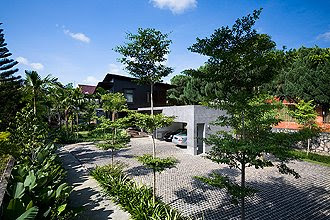 This 9,000 sq ft bungalow in Cable Road shielded by lush greenery is hard to spot, making it a sanctuary. -- PHOTOS: ALBERT SIM KOON SENG, JEREMY SAN
But a two-storey bungalow off River Valley Road whispers discreet luxury as a $1.6-million modern interpretation of the humble kampung home.
It is a hard-to-spot yet huge house of 9,000 sq ft along the small enclave of Cable Road, shielded by lush greenery.
 Echoing the design of traditional village houses, it boasts natural ventilation and lighting through louvres and lightwells (above) all around.
Drive past it and you are likely to see just a small portion of the front of the house with the garage. But there is much more to this home. The most interesting feature is that its design echoes that of kampung, or village, houses.
As with most such houses, it is in a rectangular shape, but with extensions in the form of a verandah and balcony.
 From far, it appears like a box lifted from the ground, as if built on stilts.
Its architect, Mr Yip Yuen Hong, 50, a partner at local firm ip:li architects, describes the house as 'a derivative on the kampung house'.
In its hideaway location, shielded by bamboo trees, he says, the home is a sanctuary and a place of relaxation, so 'it is not visible'.
 A shaded terrace on the ground floor looks out to the swimming pool.
The Cable Road House is one of 26 homes featured in a new book called Singapore Houses, which showcases works by 20 of Singapore's best architects. It is written by British architect and urban designer Robert Powell. Architectural photographer Albert Lim shot the homes.
The beautiful home is a 'Singapore home' not only because of its location but also because of its architecture.
 There is no need for air-con with all the louvres that allow the breeze to enter (left).
Although he grew up living in a shophouse, Mr Yip has a soft spot for kampung houses as 'they are traditional homes that we are all familiar with'.
As well, it fits in with what is discussed at the beginning of Singapore Houses: Mr Powell writes that the houses in the book show a good grasp of the principles of designing with climate.
 A shaded terrace on the ground floor looks out to the swimming pool.
'They are concerned with orientation in relation to the sun path and to wind,' he writes.
'Overhanging eaves are part of the vocabulary that most architects draw upon, as are high ceilings, louvred walls and the use of the 'skin' of the building as a permeable filter.'
The Cable Road House fits this description. Mr Yip makes use of glazed louvres around the home which, when opened, allow breezes to enter the home. The use of deep overhanging eaves blocks out direct sunlight by providing some shade and also helps to keep the rain out.
 Bamboo trees shield the bungalow from sun and stares.
Mr Yip designed the home to be just 8m wide so that air can blow through the house freely. The use of glass folding doors encourages natural ventilation while allowing light to enter the home.
Even the choice of materials reflects this simple, natural approach.
Instead of opting for too much glass or steel, this home was constructed with concrete and lots of timber, such as native variety like balau for the walls and chengai for the flooring.
Rustic retreat
Mr Yip used specially treated steel for the roof. 'These materials look better with time, giving the home a timeless look,' he says.
The owners, who decline to be named, are a couple who live with the husband's mother.
There are two bedrooms on the ground floor. One is occupied by the owner's mother and the other is a guest room.
A shaded terrace on the ground floor looks out to the swimming pool, which also serves as a cooling device when the wind blows. The house took 16 months to build.
There are two more bedrooms on the second floor - a bedroom for the couple and another for the owner's sister when she visits.
A lightwell on the second floor just by the family room allows light to enter the home.
The couple hired Mr Yip after seeing a house in Sunset Way designed by him. It had a kampung look that they fell in love with.
However, unlike kampung houses which do not come with air-conditioning, the Cable Road house is fitted with it.
However, Mr Yip says proudly: 'The owners say the fans are enough to keep them cool.'
In the first of a four-part series on beautiful homes in Singapore, we look at a bungalow in River Valley
Some houses in Singapore scream for attention with their massive size or outlandish architecture.
 This 9,000 sq ft bungalow in Cable Road shielded by lush greenery is hard to spot, making it a sanctuary. -- PHOTOS: ALBERT SIM KOON SENG, JEREMY SAN
But a two-storey bungalow off River Valley Road whispers discreet luxury as a $1.6-million modern interpretation of the humble kampung home.
It is a hard-to-spot yet huge house of 9,000 sq ft along the small enclave of Cable Road, shielded by lush greenery.
 Echoing the design of traditional village houses, it boasts natural ventilation and lighting through louvres and lightwells (above) all around.
Drive past it and you are likely to see just a small portion of the front of the house with the garage. But there is much more to this home. The most interesting feature is that its design echoes that of kampung, or village, houses.
As with most such houses, it is in a rectangular shape, but with extensions in the form of a verandah and balcony.
 From far, it appears like a box lifted from the ground, as if built on stilts.
Its architect, Mr Yip Yuen Hong, 50, a partner at local firm ip:li architects, describes the house as 'a derivative on the kampung house'.
In its hideaway location, shielded by bamboo trees, he says, the home is a sanctuary and a place of relaxation, so 'it is not visible'.
 A shaded terrace on the ground floor looks out to the swimming pool.
The Cable Road House is one of 26 homes featured in a new book called Singapore Houses, which showcases works by 20 of Singapore's best architects. It is written by British architect and urban designer Robert Powell. Architectural photographer Albert Lim shot the homes.
The beautiful home is a 'Singapore home' not only because of its location but also because of its architecture.
 There is no need for air-con with all the louvres that allow the breeze to enter (left).
Although he grew up living in a shophouse, Mr Yip has a soft spot for kampung houses as 'they are traditional homes that we are all familiar with'.
As well, it fits in with what is discussed at the beginning of Singapore Houses: Mr Powell writes that the houses in the book show a good grasp of the principles of designing with climate.
 A shaded terrace on the ground floor looks out to the swimming pool.
 'They are concerned with orientation in relation to the sun path and to wind,' he writes.
'Overhanging eaves are part of the vocabulary that most architects draw upon, as are high ceilings, louvred walls and the use of the 'skin' of the building as a permeable filter.'
The Cable Road House fits this description. Mr Yip makes use of glazed louvres around the home which, when opened, allow breezes to enter the home. The use of deep overhanging eaves blocks out direct sunlight by providing some shade and also helps to keep the rain out.
 Bamboo trees shield the bungalow from sun and stares.
 Mr Yip designed the home to be just 8m wide so that air can blow through the house freely. The use of glass folding doors encourages natural ventilation while allowing light to enter the home.
Even the choice of materials reflects this simple, natural approach.
Instead of opting for too much glass or steel, this home was constructed with concrete and lots of timber, such as native variety like balau for the walls and chengai for the flooring.
Rustic retreat
Mr Yip used specially treated steel for the roof. 'These materials look better with time, giving the home a timeless look,' he says.
The owners, who decline to be named, are a couple who live with the husband's mother.
There are two bedrooms on the ground floor. One is occupied by the owner's mother and the other is a guest room.
A shaded terrace on the ground floor looks out to the swimming pool, which also serves as a cooling device when the wind blows. The house took 16 months to build.
There are two more bedrooms on the second floor - a bedroom for the couple and another for the owner's sister when she visits.
A lightwell on the second floor just by the family room allows light to enter the home.
The couple hired Mr Yip after seeing a house in Sunset Way designed by him. It had a kampung look that they fell in love with.
However, unlike kampung houses which do not come with air-conditioning, the Cable Road house is fitted with it.
However, Mr Yip says proudly: 'The owners say the fans are enough to keep them cool.'
Sunday, June 28, 2009
Geylang Market Reopens July 13
Source : The Straits Times, June 27, 2009
AFTER a 40-month makeover, Geylang Serai Market will reopen on July 13.
 New hygiene measures have been taken as has lighting and ventilation. Hawkers hope it will be a cultural icon and a new start from the infamous temporary Geylang Serai Market. --PHOTO: ST
Its stallholders, now at a temporary market, have good reason to want to make it 'the best market ever'.
The food hawkers want to put behind them the incident in April when tainted Indian rojak from one stall killed two people and left 152 people ill.
The rojak stallholder is still under suspension.
The original market site, to which the hawkers will be going back to, is at Jalan Turi, some 500m from the temporary one.
Originally just a single storey, the new two-storey building, with about 8,730 sq m of floor space, cost $18.2 million.
Looking forward to the new start is Mr Razak Ismail, 46, whose family owns Hajjah Mona Nasi Padang.
'The downturn and food poisoning case caused business to drop,' he said.
Added Mr Oli Abdul Latiff, 49, who runs a thosai stall and who will be the new chairman of the Market Area Sub-Committee: 'We are all very happy because the new place is very beautiful. We also think business will go up, because we are now nearer the residents.'
Mr Mohd Asaduz Zaman, vice president (architectural) for Surbana International Consultants, designed the new market with its history, lighting, ventilation and hygiene needs in mind.
'The old market was up to the standards for its time, but in the new market we've added things like disabled access, better lighting and ventilation,' he said.
Read the full report in The Sunday Times.
AFTER a 40-month makeover, Geylang Serai Market will reopen on July 13.
 New hygiene measures have been taken as has lighting and ventilation. Hawkers hope it will be a cultural icon and a new start from the infamous temporary Geylang Serai Market. --PHOTO: ST
Its stallholders, now at a temporary market, have good reason to want to make it 'the best market ever'.
The food hawkers want to put behind them the incident in April when tainted Indian rojak from one stall killed two people and left 152 people ill.
The rojak stallholder is still under suspension.
The original market site, to which the hawkers will be going back to, is at Jalan Turi, some 500m from the temporary one.
Originally just a single storey, the new two-storey building, with about 8,730 sq m of floor space, cost $18.2 million.
Looking forward to the new start is Mr Razak Ismail, 46, whose family owns Hajjah Mona Nasi Padang.
'The downturn and food poisoning case caused business to drop,' he said.
Added Mr Oli Abdul Latiff, 49, who runs a thosai stall and who will be the new chairman of the Market Area Sub-Committee: 'We are all very happy because the new place is very beautiful. We also think business will go up, because we are now nearer the residents.'
Mr Mohd Asaduz Zaman, vice president (architectural) for Surbana International Consultants, designed the new market with its history, lighting, ventilation and hygiene needs in mind.
'The old market was up to the standards for its time, but in the new market we've added things like disabled access, better lighting and ventilation,' he said.
Read the full report in The Sunday Times.
Thursday, June 25, 2009
Widjaja Family Member Buys Cree Court For $53m
Source : The Business Times, June 24, 2009
Price paid by Frankle for the freehold site on Dalvey Rd works out to $800 psf
THE Good Class Bungalow (GCB) market continues to buzz with activity.
Frankle Widjaja, a member of the family that controls the Sinar Mas group, is understood to have recently inked a deal to buy Cree Court along Dalvey Road.
 Changed hands: Cree Court, on 65,416 sq ft of land area, can be redeveloped into a maximum of four GCBs
Mr Widjaja, who sits on the boards of Asia Food & Properties and Golden Agri-Resources, is said to have signed a sale and purchase agreement to buy Cree Court for about $53 million, which works out to slightly over $800 per square foot based on the site's freehold land area of 65,416 sq ft.
Cree Court is a four-storey development comprising 12 apartments. The site is in a designated Good Class Bungalow Area, which means that it can be redeveloped only into GCBs.
Based on the minimum plot size of 1,400 square metres (about 15,069 sq ft) stipulated for a GCB, the Cree Court site can be redeveloped into a maximum of four GCBs. Of course, Mr Widjaja may also develop a single luxurious bungalow on sprawling grounds, a market watcher suggested.
The seller is The Asia Life Assurance Society, part of Tokio Marine & Nichido Fire Insurance Co group. The sale is understood to have been brokered by Peter Ng of HRL Properties and Helen Li.
The $53 million fetched for Cree Court under the recent deal is lower than the $58 million that another party had agreed to pay last year for the property. However, that deal was aborted a few months later, with the buyer forfeiting a deposit of least 10 per cent of the purchase price, BT understands.
That unsuccessful buyer is understood to be an entity linked to Agus Anwar, a Singaporean businessman linked to Kapital Asia Pte Ltd, an investment holding company.
Asia Life Assurance Society bought Cree Court in 2000 from DBS Bank for $24.07 million or $368 psf.
The bank had sold the asset as part of its strategy of divesting non-core assets.
Cree Court's latest buyer, Mr Widjaja, runs his family's China property business and is credited with spearheading the development of the Sinar Mas group's Westin Bund Center in Shanghai.
Price paid by Frankle for the freehold site on Dalvey Rd works out to $800 psf
THE Good Class Bungalow (GCB) market continues to buzz with activity.
Frankle Widjaja, a member of the family that controls the Sinar Mas group, is understood to have recently inked a deal to buy Cree Court along Dalvey Road.
 Changed hands: Cree Court, on 65,416 sq ft of land area, can be redeveloped into a maximum of four GCBs
Mr Widjaja, who sits on the boards of Asia Food & Properties and Golden Agri-Resources, is said to have signed a sale and purchase agreement to buy Cree Court for about $53 million, which works out to slightly over $800 per square foot based on the site's freehold land area of 65,416 sq ft.
Cree Court is a four-storey development comprising 12 apartments. The site is in a designated Good Class Bungalow Area, which means that it can be redeveloped only into GCBs.
Based on the minimum plot size of 1,400 square metres (about 15,069 sq ft) stipulated for a GCB, the Cree Court site can be redeveloped into a maximum of four GCBs. Of course, Mr Widjaja may also develop a single luxurious bungalow on sprawling grounds, a market watcher suggested.
The seller is The Asia Life Assurance Society, part of Tokio Marine & Nichido Fire Insurance Co group. The sale is understood to have been brokered by Peter Ng of HRL Properties and Helen Li.
The $53 million fetched for Cree Court under the recent deal is lower than the $58 million that another party had agreed to pay last year for the property. However, that deal was aborted a few months later, with the buyer forfeiting a deposit of least 10 per cent of the purchase price, BT understands.
That unsuccessful buyer is understood to be an entity linked to Agus Anwar, a Singaporean businessman linked to Kapital Asia Pte Ltd, an investment holding company.
Asia Life Assurance Society bought Cree Court in 2000 from DBS Bank for $24.07 million or $368 psf.
The bank had sold the asset as part of its strategy of divesting non-core assets.
Cree Court's latest buyer, Mr Widjaja, runs his family's China property business and is credited with spearheading the development of the Sinar Mas group's Westin Bund Center in Shanghai.
Tuesday, June 23, 2009
Simon Cheong Sells Village Centre, Again
Source : The Business Times, June 23, 2009
Property helps developer strike gold for second time
Developer Simon Cheong has pulled a rabbit out of his hat by making money from the same set of properties for a second time.
Mr Cheong's privately-held vehicle recently sold The Village Centre at Pasir Panjang and a site next door for $23 million.
 The Village Centre: Mr Cheong's family vehicle sold it for $26m in 1996, bought it back for $10.8m in 2004 and sold it for $23m recently
This is double the $10.8 million he paid a NatSteel associate for the assets in 2004.
Mr Cheong's family vehicle had sold the freehold properties to NatSteel in 1996 for $26 million.
He is not the only one to have made two rounds of money from The Village Centre and the site next door.
Property consultancy group DTZ brokered the latest deal as well as the one in 2004.
In the latest transaction, Mr Cheong's Ridge Investments has sold the properties to Hume Homes Pte Ltd, a boutique property developer controlled by Ching Chiat Kwong, Low See Ching and Tee Wee Sien.
The Village Centre, at No 3 South Buona Vista Road, is a four-storey commercial and residential building comprising shop units on the first to third levels, seven apartments on the top level and 29 basement carpark lots.
The apartments are currently vacant while retail tenants include Cold Storage, Harry's Bar and Thai restaurant Lemon Grass.
About 92 per cent of the total 23,363 sq ft net lettable area for the shop units are currently leased.
The next door plot at No 7 South Buona Vista Road is currently a surface carpark with 30 lots.
The properties can be redeveloped.
Under Master Plan 2008, The Village Centre plot is zoned for commercial and residential use with a 3.0 plot ratio (ratio of maximum potential gross floor area or GFA to land area).
The next door plot, No 7 South Buona Vista Road, is zoned for residential use with a 1.4 plot ratio.
An estimated development charge (DC) of $7 million is payable to redevelop the two plots to their maximum potential.
However, there is a major road line sitting on the two sites, which means that Hume would have to make setback provisions if it redevelops the properties.
Assuming the properties are redeveloped to their maximum Master Plan 2008 potential, the $23 million purchase price reflects a unit land price of $351 per square foot of potential GFA inclusive of the $7 million DC.
There is at least one other instance in recent years of a property trader making profit from selling the same property twice.
Lippo group sold One Phillip Street, a 999-year leasehold office block, in early 1996 for $76.8 million to Kewalram Group.
Then Lippo unit Auric Pacific bought back the 16-storey office block from Kewalram in 2006 for $37.6 million.
Last year, Auric sold the asset to New Star International Property Fund for about $99 million.
Property helps developer strike gold for second time
Developer Simon Cheong has pulled a rabbit out of his hat by making money from the same set of properties for a second time.
Mr Cheong's privately-held vehicle recently sold The Village Centre at Pasir Panjang and a site next door for $23 million.
 The Village Centre: Mr Cheong's family vehicle sold it for $26m in 1996, bought it back for $10.8m in 2004 and sold it for $23m recently
This is double the $10.8 million he paid a NatSteel associate for the assets in 2004.
Mr Cheong's family vehicle had sold the freehold properties to NatSteel in 1996 for $26 million.
He is not the only one to have made two rounds of money from The Village Centre and the site next door.
Property consultancy group DTZ brokered the latest deal as well as the one in 2004.
In the latest transaction, Mr Cheong's Ridge Investments has sold the properties to Hume Homes Pte Ltd, a boutique property developer controlled by Ching Chiat Kwong, Low See Ching and Tee Wee Sien.
The Village Centre, at No 3 South Buona Vista Road, is a four-storey commercial and residential building comprising shop units on the first to third levels, seven apartments on the top level and 29 basement carpark lots.
The apartments are currently vacant while retail tenants include Cold Storage, Harry's Bar and Thai restaurant Lemon Grass.
About 92 per cent of the total 23,363 sq ft net lettable area for the shop units are currently leased.
The next door plot at No 7 South Buona Vista Road is currently a surface carpark with 30 lots.
The properties can be redeveloped.
Under Master Plan 2008, The Village Centre plot is zoned for commercial and residential use with a 3.0 plot ratio (ratio of maximum potential gross floor area or GFA to land area).
The next door plot, No 7 South Buona Vista Road, is zoned for residential use with a 1.4 plot ratio.
An estimated development charge (DC) of $7 million is payable to redevelop the two plots to their maximum potential.
However, there is a major road line sitting on the two sites, which means that Hume would have to make setback provisions if it redevelops the properties.
Assuming the properties are redeveloped to their maximum Master Plan 2008 potential, the $23 million purchase price reflects a unit land price of $351 per square foot of potential GFA inclusive of the $7 million DC.
There is at least one other instance in recent years of a property trader making profit from selling the same property twice.
Lippo group sold One Phillip Street, a 999-year leasehold office block, in early 1996 for $76.8 million to Kewalram Group.
Then Lippo unit Auric Pacific bought back the 16-storey office block from Kewalram in 2006 for $37.6 million.
Last year, Auric sold the asset to New Star International Property Fund for about $99 million.
Thursday, June 18, 2009
Jet Li Buys $20m Bungalow
Source : The Straits Times, June 17, 2009
ACTION star Jet Li and his wife, Nina, have bought a coveted good class bungalow (GCB) on Binjai Rise for $19.8 million last month, The Business Times (BT) reported on Wednesday.
 Jet Li has reportedly bought a coveted good class bungalow on Binjai Rise for $19.8 million last month. -- PHOTO: AP
The bungalow, in the Bukit Timah area, works out to cost $871 per square foot based on the freehold land area of 22,723 square feet, said The BT report.
GCBs, with their stringent planning requirements, are the creme de la creme of Singapore's housing market. There are only about 2,400 such bungalows in Singapore.
The move is seen as a sign that Li is sinking deeper roots in Singapore, after he announced plans to set up a base in Singapore for his charity and disaster-relief group One Foundation.
The Jet Li One Foundation Singapore was registered in June 2008 and the Beijing-born Li is understood to have taken up Singapore citizenship, following in the footsteps of fellow China-born superstar Gong Li, who became a Singapore citizen last November.
According to BT, Mr Li told a Forbes Global CEO Conference here in September last year that Singapore offers the right conditions for grooming future NGO leaders.
Earlier media reports also said that Mr Li moved his two daughters and wife to Singapore in 2007 for his children's education.
Mr Li led a life of hardship as a child (his father died when he was two) but he persevered to emerge as China's overall national wushu champion for five consecutive years in the 1970s. He began his acting career in the early 1980s, starting with Shaolin Temple and today has about 40 movies under his belt.
He became a US citizen in the 1980s.
When contacted by BT, a spokeswoman for Singapore's Immigration and Checkpoints Authority declined to confirm if Mr Li is now a Singapore citizen, saying 'due to reasons of confidentiality, the ICA will not discuss individual cases publicly'.
ACTION star Jet Li and his wife, Nina, have bought a coveted good class bungalow (GCB) on Binjai Rise for $19.8 million last month, The Business Times (BT) reported on Wednesday.
 Jet Li has reportedly bought a coveted good class bungalow on Binjai Rise for $19.8 million last month. -- PHOTO: AP
The bungalow, in the Bukit Timah area, works out to cost $871 per square foot based on the freehold land area of 22,723 square feet, said The BT report.
GCBs, with their stringent planning requirements, are the creme de la creme of Singapore's housing market. There are only about 2,400 such bungalows in Singapore.
The move is seen as a sign that Li is sinking deeper roots in Singapore, after he announced plans to set up a base in Singapore for his charity and disaster-relief group One Foundation.
The Jet Li One Foundation Singapore was registered in June 2008 and the Beijing-born Li is understood to have taken up Singapore citizenship, following in the footsteps of fellow China-born superstar Gong Li, who became a Singapore citizen last November.
According to BT, Mr Li told a Forbes Global CEO Conference here in September last year that Singapore offers the right conditions for grooming future NGO leaders.
Earlier media reports also said that Mr Li moved his two daughters and wife to Singapore in 2007 for his children's education.
Mr Li led a life of hardship as a child (his father died when he was two) but he persevered to emerge as China's overall national wushu champion for five consecutive years in the 1970s. He began his acting career in the early 1980s, starting with Shaolin Temple and today has about 40 movies under his belt.
He became a US citizen in the 1980s.
When contacted by BT, a spokeswoman for Singapore's Immigration and Checkpoints Authority declined to confirm if Mr Li is now a Singapore citizen, saying 'due to reasons of confidentiality, the ICA will not discuss individual cases publicly'.
Wednesday, June 17, 2009
Jet Li Buys $20m Binjai Rise Bungalow
Source : The Business Times, June 17, 2009
Tommie Goh acquires GCB from neighbour Sam Goi
Action star Jet Li seems to be sinking deeper roots in Singapore. He and his wife, Nina, bought a good class bungalow (GCB) on Binjai Rise for $19.8 million last month. The price works out to $871 per square foot based on the freehold land area of 22,723 square feet.
 Mr Li: Spurred to set up his charitable foundation after a narrow escape from the 2004 tsunami. He moved his family to Singapore in 2007 for his children's education
Mr Li is understood to have become a Singapore citizen.
Last year, he announced plans to set up a base in Singapore for his charity and disaster-relief group One Foundation. The Jet Li One Foundation Singapore was registered in June 2008.
Mr Li had said at the Forbes Global CEO Conference here in September last year that Singapore offers the right conditions for grooming future NGO leaders.
 Ex-neighbours: Mr Goi (left) and Mr Goh had been discussing the sale on and off for the past few years
He was spurred to set up his charitable foundation after a narrow escape from the 2004 tsunami. According to earlier media reports, Mr Li moved his two daughters and wife to Singapore in 2007 for his children's education.
The Beijing-born Mr Li led a life of hardship as a child (his father died when he was two) but persevered to emerge as China's overall national wushu champion for five consecutive years in the 1970s. He began his acting career in the early 1980s, starting with Shaolin Temple and today has about 40 movies under his belt.
Mr Li became a US citizen in the 1980s.
When contacted, a spokeswoman for Singapore's Immigration and Checkpoints Authority declined to confirm if Mr Li is now a Singapore citizen. 'Due to reasons of confidentiality, the ICA will not discuss individual cases publicly,' she said.
 Mr Li was not the only luminary who picked up a GCB here in May.
2G Capital co-founder Tommie Goh bought 2A Ridley Park, next to his existing home, for $30 million or slightly over $1,100 psf.
The seller was 'popiah king' Sam Goi, executive chairman of Tee Yih Jia Food Manufacturing and an established investor in the GCB market.
Mr Goi is expected to move to a new palatial home that he has built on Nassim Road. BT understands that the two neighbours had been discussing the sale of 2A Ridley Park on and off for the past few years.
GCBs, with their stringent planning requirements, are the creme de la creme of Singapore's housing market. There are only about 2,400 such bungalows on the island.
Tommie Goh acquires GCB from neighbour Sam Goi
Action star Jet Li seems to be sinking deeper roots in Singapore. He and his wife, Nina, bought a good class bungalow (GCB) on Binjai Rise for $19.8 million last month. The price works out to $871 per square foot based on the freehold land area of 22,723 square feet.
 Mr Li: Spurred to set up his charitable foundation after a narrow escape from the 2004 tsunami. He moved his family to Singapore in 2007 for his children's education
Mr Li is understood to have become a Singapore citizen.
Last year, he announced plans to set up a base in Singapore for his charity and disaster-relief group One Foundation. The Jet Li One Foundation Singapore was registered in June 2008.
Mr Li had said at the Forbes Global CEO Conference here in September last year that Singapore offers the right conditions for grooming future NGO leaders.
 Ex-neighbours: Mr Goi (left) and Mr Goh had been discussing the sale on and off for the past few years
He was spurred to set up his charitable foundation after a narrow escape from the 2004 tsunami. According to earlier media reports, Mr Li moved his two daughters and wife to Singapore in 2007 for his children's education.
The Beijing-born Mr Li led a life of hardship as a child (his father died when he was two) but persevered to emerge as China's overall national wushu champion for five consecutive years in the 1970s. He began his acting career in the early 1980s, starting with Shaolin Temple and today has about 40 movies under his belt.
Mr Li became a US citizen in the 1980s.
When contacted, a spokeswoman for Singapore's Immigration and Checkpoints Authority declined to confirm if Mr Li is now a Singapore citizen. 'Due to reasons of confidentiality, the ICA will not discuss individual cases publicly,' she said.
 Mr Li was not the only luminary who picked up a GCB here in May.
2G Capital co-founder Tommie Goh bought 2A Ridley Park, next to his existing home, for $30 million or slightly over $1,100 psf.
The seller was 'popiah king' Sam Goi, executive chairman of Tee Yih Jia Food Manufacturing and an established investor in the GCB market.
Mr Goi is expected to move to a new palatial home that he has built on Nassim Road. BT understands that the two neighbours had been discussing the sale of 2A Ridley Park on and off for the past few years.
GCBs, with their stringent planning requirements, are the creme de la creme of Singapore's housing market. There are only about 2,400 such bungalows on the island.
Monday, June 15, 2009
Dempsey: White Hot Or Too Hot?
Source : The Straits Times, June 13, 2009
Yet another F&B cluster is to open on hilltop area come September
TANGLIN Village, already home to the hip, hungry and thirsty, is getting a third lifestyle cluster.
Five furniture shops now occupying the seven blocks slated for this new cluster along Dempsey Road will move out by the end of this month.

In their place come September: A $2 million lifestyle complex called 6ix and 7even @ Dempsey, comprising restaurants, bars and retailers taking up 11 units.
The master tenant for this part of Tanglin Village is Forward Alliance, a logistics and warehousing company making its first foray into the food and beverage (F&B) industry. It is now sourcing for tenants to rival the two other nearby clusters of restaurants and bars in Dempsey Hill and Dempsey Hill Green.
Forward Alliance has a few tricks up its sleeve. It plans to bring in restaurants that will serve food that is new in the neighbourhood such as fusion cuisine; 'live' music joints are also on the cards.
It is planning to have a bicycle boutique housed in a 300 sq m space as well - a one-stop store for bicycle enthusiasts with a cafe, bicycle racks and services like showers and limousine transport home for tired cyclists and their wheels.
Another novel idea: A caravan park-turned-restaurant. Forward Alliance plans to import about five caravans of between 30 sq m and 50 sq m in size, and then kit them out as private dining rooms for up to 12 people.
The debut of 6ix and 7even @ Dempsey will mark the latest chapter in the area's transformation from sleepy furniture town to hip dining and drinking destination.
Nearly half of the 72 businesses there now are restaurants or bars, each paying rents of between $8 and $15 per sq ft.
Tanglin Village started out in the 1860s as army barracks. In the 1990s, it became known for its furniture shops. Then in 2004, the Singapore Land Authority (SLA) stepped up its search for tenants who would put the pre-war blocks to other uses.
In came upmarket restaurants and wine bars such as Oosh and PS Cafe. Schools, shops, art galleries and offices also moved in.
In 2007, when Country City Investment (CCI) opened the Dempsey Hill and Dempsey Hill Green F&B clusters, the buzz in the area went up several notches.
CCI is now taking over several more Dempsey Road blocks to expand these two clusters. Several furniture shop tenants in this area moved out in February, complaining of rocketing rents.
So the entrance of yet another F&B cluster poses the question: Is the hot spot getting too hot for its own good?
After all, there are signs that the Government is getting wary of overkill. The Straits Times understands that for the upcoming Dempsey Hill expansion, the SLA has capped the amount of space occupied by F&B outlets to 20 per cent of the area.
The SLA has also stipulated that some space should be used by furniture shops, in an apparent bid to preserve the original feel of the place.
But real estate experts - and Dempsey F&B owners themselves - say the area still has room to grow. They also say its unique charm, thanks to the greenery and old buildings, will continue to attract diners.
Mr Michel Lu, who owns the Hacienda bar, said: 'The nice thing is that the buildings are quite spread out. It is very green, not compact, and does not feel like Singapore.' He is so upbeat about the growth prospects of the place that he is building a cafe extension to Hacienda. It will open in a month.
Mr Danny Yeo, managing director of property consultancy Knight Frank, said the success of the place depends on its variety of offerings. So as long as the new operator creates new concepts, then it should still do well, he said.
Mr Eric Cheng, executive director of property consultancy HSR, said master tenants will also need to choose their sub-tenants carefully to protect the area's upmarket atmosphere.
'Look at Pasir Panjang Village. It used to have that 'niche restaurant' feel. But now, it is just not really there,' he said.
Foodie Michelle Quah, who has been to Tanglin Village only thrice since its redevelopment, said the offerings will have to be more than just 'pleasant but predictable' to draw her back there.
Referring to the upcoming outlets, the 29-year-old legal counsel said: 'The food, decor and experience must set them apart from any of your usual yuppie haunts.'
Yet another F&B cluster is to open on hilltop area come September
TANGLIN Village, already home to the hip, hungry and thirsty, is getting a third lifestyle cluster.
Five furniture shops now occupying the seven blocks slated for this new cluster along Dempsey Road will move out by the end of this month.

In their place come September: A $2 million lifestyle complex called 6ix and 7even @ Dempsey, comprising restaurants, bars and retailers taking up 11 units.
The master tenant for this part of Tanglin Village is Forward Alliance, a logistics and warehousing company making its first foray into the food and beverage (F&B) industry. It is now sourcing for tenants to rival the two other nearby clusters of restaurants and bars in Dempsey Hill and Dempsey Hill Green.
Forward Alliance has a few tricks up its sleeve. It plans to bring in restaurants that will serve food that is new in the neighbourhood such as fusion cuisine; 'live' music joints are also on the cards.
It is planning to have a bicycle boutique housed in a 300 sq m space as well - a one-stop store for bicycle enthusiasts with a cafe, bicycle racks and services like showers and limousine transport home for tired cyclists and their wheels.
Another novel idea: A caravan park-turned-restaurant. Forward Alliance plans to import about five caravans of between 30 sq m and 50 sq m in size, and then kit them out as private dining rooms for up to 12 people.
The debut of 6ix and 7even @ Dempsey will mark the latest chapter in the area's transformation from sleepy furniture town to hip dining and drinking destination.
Nearly half of the 72 businesses there now are restaurants or bars, each paying rents of between $8 and $15 per sq ft.
Tanglin Village started out in the 1860s as army barracks. In the 1990s, it became known for its furniture shops. Then in 2004, the Singapore Land Authority (SLA) stepped up its search for tenants who would put the pre-war blocks to other uses.
In came upmarket restaurants and wine bars such as Oosh and PS Cafe. Schools, shops, art galleries and offices also moved in.
In 2007, when Country City Investment (CCI) opened the Dempsey Hill and Dempsey Hill Green F&B clusters, the buzz in the area went up several notches.
CCI is now taking over several more Dempsey Road blocks to expand these two clusters. Several furniture shop tenants in this area moved out in February, complaining of rocketing rents.
So the entrance of yet another F&B cluster poses the question: Is the hot spot getting too hot for its own good?
After all, there are signs that the Government is getting wary of overkill. The Straits Times understands that for the upcoming Dempsey Hill expansion, the SLA has capped the amount of space occupied by F&B outlets to 20 per cent of the area.
The SLA has also stipulated that some space should be used by furniture shops, in an apparent bid to preserve the original feel of the place.
But real estate experts - and Dempsey F&B owners themselves - say the area still has room to grow. They also say its unique charm, thanks to the greenery and old buildings, will continue to attract diners.
Mr Michel Lu, who owns the Hacienda bar, said: 'The nice thing is that the buildings are quite spread out. It is very green, not compact, and does not feel like Singapore.' He is so upbeat about the growth prospects of the place that he is building a cafe extension to Hacienda. It will open in a month.
Mr Danny Yeo, managing director of property consultancy Knight Frank, said the success of the place depends on its variety of offerings. So as long as the new operator creates new concepts, then it should still do well, he said.
Mr Eric Cheng, executive director of property consultancy HSR, said master tenants will also need to choose their sub-tenants carefully to protect the area's upmarket atmosphere.
'Look at Pasir Panjang Village. It used to have that 'niche restaurant' feel. But now, it is just not really there,' he said.
Foodie Michelle Quah, who has been to Tanglin Village only thrice since its redevelopment, said the offerings will have to be more than just 'pleasant but predictable' to draw her back there.
Referring to the upcoming outlets, the 29-year-old legal counsel said: 'The food, decor and experience must set them apart from any of your usual yuppie haunts.'
Divide & Prosper?
Source : The Straits Times, June 12, 2009
Some landlords are partitioning apartments and renting them out for a larger profit even though it is illegal
THE practice of illegally partitioning apartments to create more units for rent is widespread, said real estate agents.
 At one apartment in Holland Crest, paper labels have been placed next to the doors leading to the partitioned units in order to distinguish them. -- ST PHOTO: MUGILAN RAJASEGERAN
Checks by The Straits Times at 20 developments found 11 had apartments or houses that had been subdivided into smaller rental units or broken into many rooms, in areas such as Orchard, Chinatown, Little India and Bukit Timah.
Last year, the Urban Redevelopment Authority (URA) acted on 400 such cases, most of which involved illegal refurbishment of dwellings for unauthorised use as workers' dormitories. This year, there were 90 cases from January to April.
The practice was highlighted recently when tenants at The Grangeford in Leonie Hill were asked to move out of their illegally subdivided units.
The Grangeford case was unusual because so many units in the condominium had been subdivided.
 This overflowing shoe rack parked outside a room in one of the illegal units is a tell-tale sign of how many tenants are being crowded into the room. -- ST PHOTO: ANG YIYING
But up to 10 per cent of developments in areas popular with renters - such as Geylang, Joo Chiat or near Chinatown - might have partitioned or subdivided apartments, said Dennis Wee Group vice-president Alex Leow.
Checks by The Straits Times at 20 developments islandwide found that such units had attracted not only foreigners working in the service industry, but also visitors needing short-term accommodation such as medical tourists, students and office workers who wanted cheap rental accommodation near town.
Some apartments were divided into two, with the kitchen on one side. Other apartments were partitioned to create more bedrooms; the toilets and kitchen were shared. Some did away with the kitchen to allow for an additional room.
Another agent said subdivisions were more common in older apartments, especially those up for collective sale. Such apartmentsare unpopular with expatriate families, who are put off by the ageing facilities and uncertain leases. Subdividing them makes them attractive shorter-term accommodation.
Claiming that subdivisions were the norm in popular rental districts, real estate agent Benny Teo, 37, said: 'Don't talk about poor foreign workers. Even office workers earning up to $5,000 are looking to save a lot on rent by sharing a large partitioned unit with a friend as it might cost them only about $1,400.'
Another property agent, Mr Tan Weixiong, 36, said demand for such units is so great that a day after a subdivided or partitioned apartment is advertised, all the units are snapped up.
 At The Grangeford, URA discovered in April that 600 units had been carved out of 140 apartments. -- BT FILE PHOTO
This practice of converting individual homes into boarding houses is not condoned by URA, which says it poses safety issues for other residents. URA has said it will step up enforcement measures to stamp out the practice.
At Kimsia Court, located in the Orchard area, the management has dealt with such cases before, taking action by informing the authorities about the subdivided units, said resident and management corporation treasurer Tony Thong.
He said that at one of the apartments there, two of the bedrooms and the maid's room had been divided into six rooms last year. Each subdivision had its own lock and key.
Agents said such housing 'solutions' had sprung up because of the increasing number of foreign workers in Singapore who need cheaper accommodation. Last year, the island's foreign population surged past the one million mark for the first time.
Many tenants are attracted by what they see as a good deal - affordable rates, convenient locations, more exclusive accommodation and condo facilities.
Thai postgraduate student May Eddison, who has lived in a partitioned unit in Holland Crest since December, said the $1,800 she pays in rent is worth it because the condo has a swimming pool and is located near Holland Village and the National University of Singapore.
'We also get a fairly big unit, with a bedroom, a kitchen and a small living room. But I feel rather trapped sometimes as there is no window, and it's inconvenient having to leave my unit to go to the toilet, which we share with the other tenants,' said Mrs Eddison, who lives there with her husband.
At Moonstone Apartments in Bendemeer, a 40-year-old IT professional from the Philippines who rents a subdivided unit there said he liked the quiet environment, which he said he would not find in an HDB estate.
Property agent A.L. Tay, 41, noted: 'If you clamp down on these places, where are these people going to go?'
However, URA said there was enough accommodation to go around, including affordable rental homes. 'There are currently about 240,000 private residential units in the market for owner occupation or for rental.
'As rentals of private properties have been moderating since peaking in the second quarter of 2008, a wider range of private housing has become more affordable, meeting the different budget needs of foreign residents.'
But where there is demand, there will be supply, it seems. Dennis Wee Group's Mr Leow estimated that a 2,000 sq ft apartment in Katong or Chinatown could rake in $3,000 if rented out whole, but could fetch $5,000 altogether if broken up into five subdivisions asking $1,000 each.
'Of course, if you have more rooms, you get more money,' said one landlord, who wanted to remain anonymous.
Some landlords are partitioning apartments and renting them out for a larger profit even though it is illegal
THE practice of illegally partitioning apartments to create more units for rent is widespread, said real estate agents.
 At one apartment in Holland Crest, paper labels have been placed next to the doors leading to the partitioned units in order to distinguish them. -- ST PHOTO: MUGILAN RAJASEGERAN
Checks by The Straits Times at 20 developments found 11 had apartments or houses that had been subdivided into smaller rental units or broken into many rooms, in areas such as Orchard, Chinatown, Little India and Bukit Timah.
Last year, the Urban Redevelopment Authority (URA) acted on 400 such cases, most of which involved illegal refurbishment of dwellings for unauthorised use as workers' dormitories. This year, there were 90 cases from January to April.
The practice was highlighted recently when tenants at The Grangeford in Leonie Hill were asked to move out of their illegally subdivided units.
The Grangeford case was unusual because so many units in the condominium had been subdivided.
 This overflowing shoe rack parked outside a room in one of the illegal units is a tell-tale sign of how many tenants are being crowded into the room. -- ST PHOTO: ANG YIYING
But up to 10 per cent of developments in areas popular with renters - such as Geylang, Joo Chiat or near Chinatown - might have partitioned or subdivided apartments, said Dennis Wee Group vice-president Alex Leow.
Checks by The Straits Times at 20 developments islandwide found that such units had attracted not only foreigners working in the service industry, but also visitors needing short-term accommodation such as medical tourists, students and office workers who wanted cheap rental accommodation near town.
Some apartments were divided into two, with the kitchen on one side. Other apartments were partitioned to create more bedrooms; the toilets and kitchen were shared. Some did away with the kitchen to allow for an additional room.
Another agent said subdivisions were more common in older apartments, especially those up for collective sale. Such apartmentsare unpopular with expatriate families, who are put off by the ageing facilities and uncertain leases. Subdividing them makes them attractive shorter-term accommodation.
Claiming that subdivisions were the norm in popular rental districts, real estate agent Benny Teo, 37, said: 'Don't talk about poor foreign workers. Even office workers earning up to $5,000 are looking to save a lot on rent by sharing a large partitioned unit with a friend as it might cost them only about $1,400.'
Another property agent, Mr Tan Weixiong, 36, said demand for such units is so great that a day after a subdivided or partitioned apartment is advertised, all the units are snapped up.
 At The Grangeford, URA discovered in April that 600 units had been carved out of 140 apartments. -- BT FILE PHOTO
This practice of converting individual homes into boarding houses is not condoned by URA, which says it poses safety issues for other residents. URA has said it will step up enforcement measures to stamp out the practice.
At Kimsia Court, located in the Orchard area, the management has dealt with such cases before, taking action by informing the authorities about the subdivided units, said resident and management corporation treasurer Tony Thong.
He said that at one of the apartments there, two of the bedrooms and the maid's room had been divided into six rooms last year. Each subdivision had its own lock and key.
Agents said such housing 'solutions' had sprung up because of the increasing number of foreign workers in Singapore who need cheaper accommodation. Last year, the island's foreign population surged past the one million mark for the first time.
Many tenants are attracted by what they see as a good deal - affordable rates, convenient locations, more exclusive accommodation and condo facilities.
Thai postgraduate student May Eddison, who has lived in a partitioned unit in Holland Crest since December, said the $1,800 she pays in rent is worth it because the condo has a swimming pool and is located near Holland Village and the National University of Singapore.
'We also get a fairly big unit, with a bedroom, a kitchen and a small living room. But I feel rather trapped sometimes as there is no window, and it's inconvenient having to leave my unit to go to the toilet, which we share with the other tenants,' said Mrs Eddison, who lives there with her husband.
At Moonstone Apartments in Bendemeer, a 40-year-old IT professional from the Philippines who rents a subdivided unit there said he liked the quiet environment, which he said he would not find in an HDB estate.
Property agent A.L. Tay, 41, noted: 'If you clamp down on these places, where are these people going to go?'
However, URA said there was enough accommodation to go around, including affordable rental homes. 'There are currently about 240,000 private residential units in the market for owner occupation or for rental.
'As rentals of private properties have been moderating since peaking in the second quarter of 2008, a wider range of private housing has become more affordable, meeting the different budget needs of foreign residents.'
But where there is demand, there will be supply, it seems. Dennis Wee Group's Mr Leow estimated that a 2,000 sq ft apartment in Katong or Chinatown could rake in $3,000 if rented out whole, but could fetch $5,000 altogether if broken up into five subdivisions asking $1,000 each.
'Of course, if you have more rooms, you get more money,' said one landlord, who wanted to remain anonymous.
Firm Has Partitioned Units At Several Sites
Source : The Straits Times, June 12, 2009
IDEAL Accommodation, which was behind the unauthorised refurbishment of The Grangeford condominium, is renting out partitioned apartments in at least five other developments, checks by The Straits Times found.
 One is Holland Crest, a development which was sold in a collective sale in 2007 to BBR Group.
Residents moved out last year, and Ideal moved in to lease the empty apartments to tenants.
At least two blocks on the grounds - blocks 19 and 21 - have partitioned units on every floor.
Residents, who are expatriates, students and long-term tourists, say they pay about $1,800 per partitioned unit per month.
At Dalvey Court, off Stevens Road, a walk-up apartment complex which had nine units originally, each apartment has been partitioned into three or four units.
One studio unit - with a master bedroom and balcony - was going for $1,300.
Some partitioned units were also found at Moonstone Apartments near Serangoon Road, No. 8 Kim Keat Road and No. 144 Race Course Road.
Ideal was the master tenant of The Grangeford condominium in Leonie Hill Road but was booted out by the owner of the property after it failed to comply with an order by the Urban Redevelopment Authority (URA) to remove and restore its 600 partitioned rooms.
Tenants were told of the URA order very late, leaving them little time to clear out.
A check on the company under the Accounting and Corporate Regulatory Authority shows that the two directors in charge are Mr Tang Yong, a Singapore PR, and Ms Tang Xuemei, a Chinese national.
The company, started in 2004, has $170,000 in capital.
Mr Tang Yong was uncontactable for a response.
URA would say only that it is 'already following up on the feedback received on residential properties managed by Ideal Accommodation'.
When partitioning of apartments is illegal
AN URBAN Redevelopment Authority (URA) spokesman said adding partitions inside homes for family use is not illegal but letting out the partitioned units to multiple tenants, so that it becomes a dormitory, hostel or boarding house, is.
'Residences with such unauthorised uses cause disamenity and inconvenience to residents and pose public safety concerns,' said its spokesman. For instance, People's Park Centre resident Don Kok, 30, said some owners partition their kitchens to rent out, blocking off the common rubbish chute.
URA said unauthorised additions and alterations to apartments must be demolished and its use reverted to being a single dwelling.
The Singapore Civil Defence Force (SCDF) also acts against such illegal partitioning.
It issued 527 notices last year and 264 notices between January and April for unauthorised conversions to workers' quarters. Partitioning a dorm could compromise fire safety and it requires SCDF approval.
IDEAL Accommodation, which was behind the unauthorised refurbishment of The Grangeford condominium, is renting out partitioned apartments in at least five other developments, checks by The Straits Times found.
 One is Holland Crest, a development which was sold in a collective sale in 2007 to BBR Group.
Residents moved out last year, and Ideal moved in to lease the empty apartments to tenants.
At least two blocks on the grounds - blocks 19 and 21 - have partitioned units on every floor.
Residents, who are expatriates, students and long-term tourists, say they pay about $1,800 per partitioned unit per month.
At Dalvey Court, off Stevens Road, a walk-up apartment complex which had nine units originally, each apartment has been partitioned into three or four units.
One studio unit - with a master bedroom and balcony - was going for $1,300.
Some partitioned units were also found at Moonstone Apartments near Serangoon Road, No. 8 Kim Keat Road and No. 144 Race Course Road.
Ideal was the master tenant of The Grangeford condominium in Leonie Hill Road but was booted out by the owner of the property after it failed to comply with an order by the Urban Redevelopment Authority (URA) to remove and restore its 600 partitioned rooms.
Tenants were told of the URA order very late, leaving them little time to clear out.
A check on the company under the Accounting and Corporate Regulatory Authority shows that the two directors in charge are Mr Tang Yong, a Singapore PR, and Ms Tang Xuemei, a Chinese national.
The company, started in 2004, has $170,000 in capital.
Mr Tang Yong was uncontactable for a response.
URA would say only that it is 'already following up on the feedback received on residential properties managed by Ideal Accommodation'.
When partitioning of apartments is illegal
AN URBAN Redevelopment Authority (URA) spokesman said adding partitions inside homes for family use is not illegal but letting out the partitioned units to multiple tenants, so that it becomes a dormitory, hostel or boarding house, is.
'Residences with such unauthorised uses cause disamenity and inconvenience to residents and pose public safety concerns,' said its spokesman. For instance, People's Park Centre resident Don Kok, 30, said some owners partition their kitchens to rent out, blocking off the common rubbish chute.
URA said unauthorised additions and alterations to apartments must be demolished and its use reverted to being a single dwelling.
The Singapore Civil Defence Force (SCDF) also acts against such illegal partitioning.
It issued 527 notices last year and 264 notices between January and April for unauthorised conversions to workers' quarters. Partitioning a dorm could compromise fire safety and it requires SCDF approval.
Time May Run Out For Keppel Club
Source : The Business Times, June 13, 2009
Lease may not be renewed as prime site can be put to other uses
ONE of Singapore's best-known golf clubs could be forced to give up its prime location - close to the upcoming Sentosa integrated resort - and seek a new home.
BT understands from industry sources that the lease on Keppel Club's site near Telok Blangah, across from Sentosa Island, might not be renewed when it expires in just over 11 years as the land has been earmarked for redevelopment.
 KEPPEL COUNTRY CLUB - Members could be asked to cough up cash for part of the new redevelopment
A senior club official declined to comment when reached and members said they had not been told of any potential changes. When contacted, the Singapore Land Authority, which is the lessor of the land, issued a one-line statement which read: '10 Bukit Chermin Road is on a 30-year lease to Keppel Club. The lease expires end-2021.'
Land-scarce Singapore already has 11 golf clubs with transferable memberships, including a combination of proprietary outfits like Laguna and members' clubs like Singapore Island & Country Club. There are also several public and quasi-public courses like Marina Bay and NSR Country Club.
All sit on land which are leased on 30-year terms from landlords who include the Public Utilities Board, Jurong Town Corporation and other government agencies. Most have had no problems getting their leases renewed.
But the development of the Sentosa Island, with its Integrated Resorts, has increased the value of the land around the vicinity. The area has seen massive redevelopment with prime waterfront commercial and residential properties like VivoCity, Keppel Corp's Reflections and Caribbean.
'This is prime property,' said an informed industry insider. 'Most golf clubs in Singapore sit on water catchment areas, land adjacent airports or other real estate which cannot house infrastructure. Having a golf club on this Bukit Chermin site is the least productive use of prime land in land-scarce Singapore.'
Going by past practises, this means Keppel Club could be offered a new location. But given that the construction of an 18-hole golf course and full club facilities could easily take five years or more (after several years to source a suitable location), Keppel will have to work quickly.
And with the cost of development likely to be around $100 million, there is also the question of funding.
According to the club's annual report, it had just over $20 million in cash. This means members could be asked to cough up cash for part of the new redevelopment. But the Port of Singapore Authority, which became patron of the club in 1973, could also help finance part of the redevelopment.
The last time that a golf club relocated was about a decade ago, when Warren moved from Kent Ridge to Choa Chu Kang and members had to pay a tidy sum each.
Keppel Golf Club, as it was originally known, was founded on November 1904 on a piece of land first owned by the New Dock Co Ltd. The land and club were later transferred to the Tanjong Pagar Dock Board. The Singapore Harbour Board subsequently took over that piece of land.
By 1973, when PSA took over its operation, Keppel Club occupied approximately 43 acres of PSA-owned land. Four years later, in 1977, PSA leased more land to Keppel Club for the extension of the golf course. By 1980, ambitious plans were fast underway to remodel and upgrade the 18-hole to a new 6,000 metre Ronald Fream-designed golf competition course.
Some $14 million was spent refurbishing the golf course and clubhouse. More upgrading works were carried out in 1994. $22 million bought members a bowling centre, gymnasium, outdoor and indoor tennis courts, movie house and the Olympic-sized swimming pool.
In 2005, a Master Plan was presented to the members to further expand the facilities to take advantage of the sea view, with a sea fronting gymnasium and dancing/aerobic studio, a boardwalk offering alfresco dining, children's play area, video games arcade and roof top dining area. A new multi-storey carpark was also built.
Lease may not be renewed as prime site can be put to other uses
ONE of Singapore's best-known golf clubs could be forced to give up its prime location - close to the upcoming Sentosa integrated resort - and seek a new home.
BT understands from industry sources that the lease on Keppel Club's site near Telok Blangah, across from Sentosa Island, might not be renewed when it expires in just over 11 years as the land has been earmarked for redevelopment.
 KEPPEL COUNTRY CLUB - Members could be asked to cough up cash for part of the new redevelopment
A senior club official declined to comment when reached and members said they had not been told of any potential changes. When contacted, the Singapore Land Authority, which is the lessor of the land, issued a one-line statement which read: '10 Bukit Chermin Road is on a 30-year lease to Keppel Club. The lease expires end-2021.'
Land-scarce Singapore already has 11 golf clubs with transferable memberships, including a combination of proprietary outfits like Laguna and members' clubs like Singapore Island & Country Club. There are also several public and quasi-public courses like Marina Bay and NSR Country Club.
All sit on land which are leased on 30-year terms from landlords who include the Public Utilities Board, Jurong Town Corporation and other government agencies. Most have had no problems getting their leases renewed.
But the development of the Sentosa Island, with its Integrated Resorts, has increased the value of the land around the vicinity. The area has seen massive redevelopment with prime waterfront commercial and residential properties like VivoCity, Keppel Corp's Reflections and Caribbean.
'This is prime property,' said an informed industry insider. 'Most golf clubs in Singapore sit on water catchment areas, land adjacent airports or other real estate which cannot house infrastructure. Having a golf club on this Bukit Chermin site is the least productive use of prime land in land-scarce Singapore.'
Going by past practises, this means Keppel Club could be offered a new location. But given that the construction of an 18-hole golf course and full club facilities could easily take five years or more (after several years to source a suitable location), Keppel will have to work quickly.
And with the cost of development likely to be around $100 million, there is also the question of funding.
According to the club's annual report, it had just over $20 million in cash. This means members could be asked to cough up cash for part of the new redevelopment. But the Port of Singapore Authority, which became patron of the club in 1973, could also help finance part of the redevelopment.
The last time that a golf club relocated was about a decade ago, when Warren moved from Kent Ridge to Choa Chu Kang and members had to pay a tidy sum each.
Keppel Golf Club, as it was originally known, was founded on November 1904 on a piece of land first owned by the New Dock Co Ltd. The land and club were later transferred to the Tanjong Pagar Dock Board. The Singapore Harbour Board subsequently took over that piece of land.
By 1973, when PSA took over its operation, Keppel Club occupied approximately 43 acres of PSA-owned land. Four years later, in 1977, PSA leased more land to Keppel Club for the extension of the golf course. By 1980, ambitious plans were fast underway to remodel and upgrade the 18-hole to a new 6,000 metre Ronald Fream-designed golf competition course.
Some $14 million was spent refurbishing the golf course and clubhouse. More upgrading works were carried out in 1994. $22 million bought members a bowling centre, gymnasium, outdoor and indoor tennis courts, movie house and the Olympic-sized swimming pool.
In 2005, a Master Plan was presented to the members to further expand the facilities to take advantage of the sea view, with a sea fronting gymnasium and dancing/aerobic studio, a boardwalk offering alfresco dining, children's play area, video games arcade and roof top dining area. A new multi-storey carpark was also built.
Saturday, June 6, 2009
Grangeford Condo Eviction - Torn Between 2 'Landlords'
Source : The Straits Times, June 5, 2009
Firms dispute property; residents await deposit returns, move-out date
THE owner and master tenant of an illegally refurbished condominium are now tussling over who the rightful landlord is of the property, leaving 200 residents wondering when they have to move out and what will become of their security deposits.
 A Grangeford tenant, who wished to be known only as Joy, expressing her frustrations at a meeting held last night with property owners Cove Developments. -- ST PHOTO: SHAHRIYA YAHAYA
At separate meetings with residents on Thursday, both parties gave them different dates to move out of The Grangeford in Leonie Hill.
The master tenant, Ideal Accommodation, which had carried out the renovations and rented out the rooms, said they could move out by the end of this month, while property owner Cove Development has given them till June 14.
Tenants do not know who to believe, but noted that they have a legal contract with Ideal, and not with Cove.
They were asked to go after the Urban Redevelopment Authority (URA) discovered that Ideal had illegally partitioned apartments in the condo - sold en bloc in 2007 - to create 600 sub-units from 140 units.
URA told Ideal on April 29 to tear down the partitions by Wednesday, but most tenants were told only on Sunday, giving them three days to clear out.
On Wednesday, Cove Development, a unit of Overseas Union Enterprise (OUE), terminated Ideal's two-year lease and gained an extension from the URA till July 27 to remove the partitions.
But yesterday, in its first meeting with tenants in a week, Ideal said that its contracts with tenants still stand, and so does its lease agreement with Cove.
A representative, who identified himself as Mr Lee, said to the crowd: 'We don't care what Cove says.'
In response, Mr Steven Ngai, company secretary for OUE, told The Straits Times: 'If the tenants want to listen to Ideal and get cheated, don't blame Cove.'
Read the full story in Friday's edition of The Straits Times.
Firms dispute property; residents await deposit returns, move-out date
THE owner and master tenant of an illegally refurbished condominium are now tussling over who the rightful landlord is of the property, leaving 200 residents wondering when they have to move out and what will become of their security deposits.
 A Grangeford tenant, who wished to be known only as Joy, expressing her frustrations at a meeting held last night with property owners Cove Developments. -- ST PHOTO: SHAHRIYA YAHAYA
At separate meetings with residents on Thursday, both parties gave them different dates to move out of The Grangeford in Leonie Hill.
The master tenant, Ideal Accommodation, which had carried out the renovations and rented out the rooms, said they could move out by the end of this month, while property owner Cove Development has given them till June 14.
Tenants do not know who to believe, but noted that they have a legal contract with Ideal, and not with Cove.
They were asked to go after the Urban Redevelopment Authority (URA) discovered that Ideal had illegally partitioned apartments in the condo - sold en bloc in 2007 - to create 600 sub-units from 140 units.
URA told Ideal on April 29 to tear down the partitions by Wednesday, but most tenants were told only on Sunday, giving them three days to clear out.
On Wednesday, Cove Development, a unit of Overseas Union Enterprise (OUE), terminated Ideal's two-year lease and gained an extension from the URA till July 27 to remove the partitions.
But yesterday, in its first meeting with tenants in a week, Ideal said that its contracts with tenants still stand, and so does its lease agreement with Cove.
A representative, who identified himself as Mr Lee, said to the crowd: 'We don't care what Cove says.'
In response, Mr Steven Ngai, company secretary for OUE, told The Straits Times: 'If the tenants want to listen to Ideal and get cheated, don't blame Cove.'
Read the full story in Friday's edition of The Straits Times.
Subscribe to:
Comments (Atom)
.jpg)